The Importance of Pigment Ink
The foundation of fine art inkjet printing is long-term stability. Prints should last not for a few years, but for several decades. This durability begins with pigment ink. Pigment inks contain tiny solid particles suspended in liquid, which makes them far more resistant to light and environmental influences than dye-based inks.
Testing by Wilhelm Imaging Research shows that certain pigment ink systems can maintain accurate colours for more than a century under suitable conditions. Macworld’s technical review of ink types reaches the same conclusion and confirms that pigment inks fade significantly less under normal lighting.
Wilhelm Imaging Research — Print Permanence Ratings
https://wilhelm-research.com
Wilhelm Imaging Research — Print Permanence Ratings
https://wilhelm-research.com
Why Archival Papers Make a Difference
Ink alone cannot ensure longevity. The material on which the print is made is equally important. Fine art papers are usually made from cotton rag or high-quality alpha-cellulose because these materials offer chemical stability. They are acid-free and lignin-free, which prevents the yellowing and breakdown that occur in standard photo papers.
Hahnemühle states that its FineArt papers follow ISO 9706, the museum standard for archival materials. The Image Permanence Institute explains that acid-free materials age far more slowly and therefore protect the artwork much better over time.
Why Archival Papers Make a Difference
Ink alone cannot ensure longevity. The material on which the print is made is equally important. Fine art papers are usually made from cotton rag or high-quality alpha-cellulose because these materials offer chemical stability. They are acid-free and lignin-free, which prevents the yellowing and breakdown that occur in standard photo papers.
Hahnemühle states that its FineArt papers follow ISO 9706, the museum standard for archival materials. The Image Permanence Institute explains that acid-free materials age far more slowly and therefore protect the artwork much better over time.
Colour Depth and Tonal Accuracy
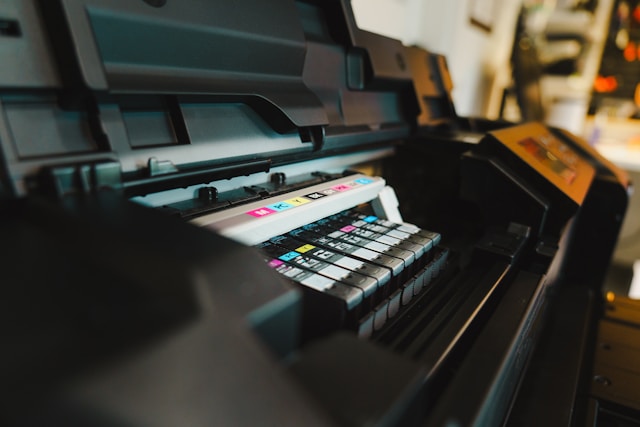
When pigment ink and archival paper are brought together, they produce a recognisable visual signature. Colours become deeper, shadows gain nuance and the surface texture enhances the overall image. Professional fine art printers often contain eight to twelve pigment ink channels, enabling very precise tonal transitions.
DPReview has tested modern pigment-based systems and found that their colour gamut surpasses that of traditional chemical photo processes. This allows for more accurate and richer reproductions of digital artwork.
Why Museums Use Pigment-Based Inkjet Prints
The strengths of fine art inkjet printing are the reason museums adopted the technique earlier than the general public. The Museum of Fine Arts in Boston uses pigment inkjet prints for digital editions and certain exhibition materials. The Metropolitan Museum of Art documents similar use in its conservation and imaging department.
These institutions consider pigment inkjet printing to be a stable, reliable and appropriate medium for high-quality reproductions.
The Characteristic Look of Fine Art Prints
People often refer to the specific “look” of a fine art print. This includes dense blacks, smooth transitions in highlights and a tactile quality that gives the image presence. The natural texture of cotton papers helps create this impression. Pigment does not sit on top of the paper but becomes part of the surface structure.
This physical integration is one reason collectors and galleries prefer pigment-based prints for limited editions.
A Process Defined by Many Choices
0Fine art inkjet printing is not based on a single feature. It is shaped by a series of deliberate decisions: the type of ink, the archival quality of the paper, the technology of the printer and the conditions in which the print is stored or displayed. When these elements work together, the result is a durable, colour-accurate and visually rich artwork that meets museum standards.
The evidence from Wilhelm Imaging Research, the Image Permanence Institute, DPReview and museum conservation departments supports this view. Fine art inkjet printing is a thoroughly tested and proven method for creating long-lasting prints.